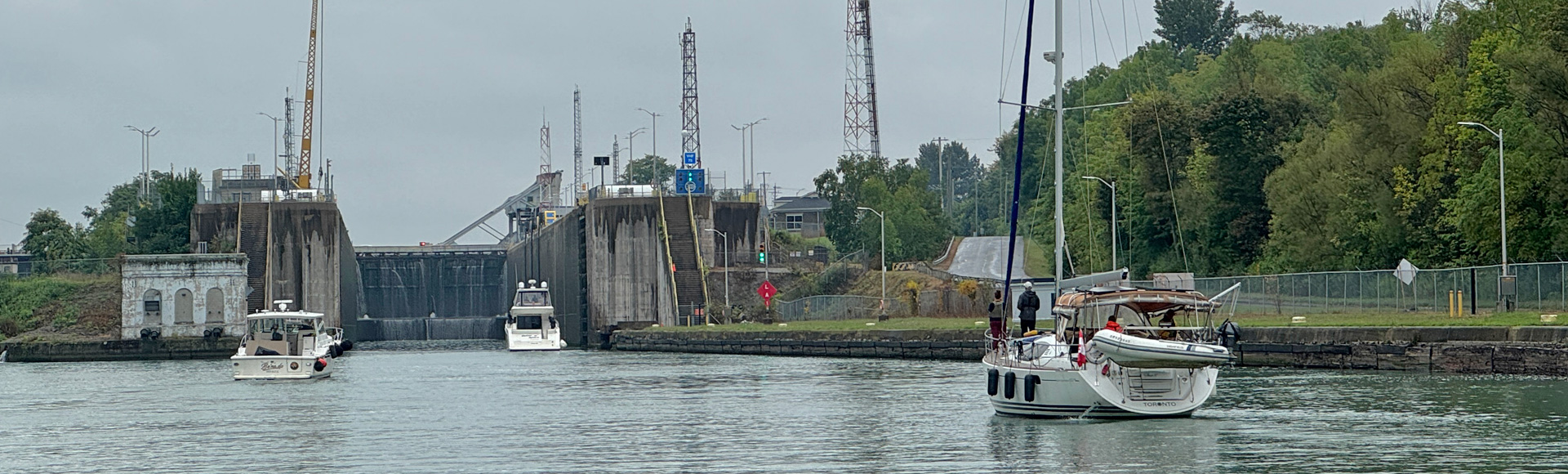
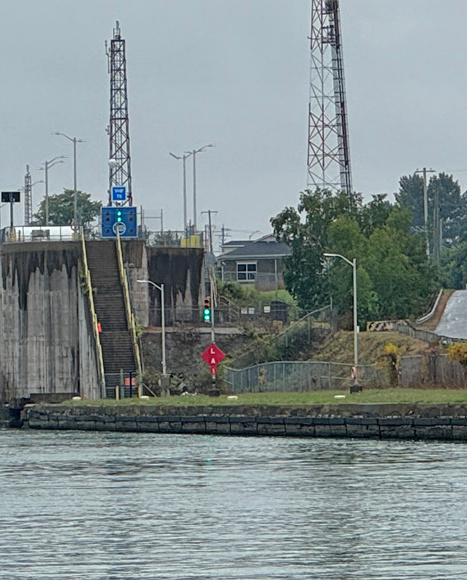
We scheduled our upbound transit of the Welland Canal for 9:00AM on Sunday August 30th. Downbound on the Welland (Lake Erie to Lake Ontario) requires 2 people on board. Upbound requires 3 people due to the increased turbulence created when the locks are filled. Once you start the transit, there is no stopping, unless you are instructed to do so by the Seaway authorities. Much to our surprise, we had friends who volunteered to help us through the locks! There are truly crazy people out there!
Staging
We had spent most of the summer sailing the Canadian side of Lake Ontario. As the end of August approached, we jumped from the charming town of Cobourg, ON across Lake Ontario to the Tuscarora channel near Wilson, NY.
The channel entrance is narrow, and you must follow the winding path through the red and green buoys to keep from running aground. Protected from Lake Ontario by Sunset Island, the channel passes a continuous run of small marinas and yacht clubs. We stayed as guests of the Wilson Yacht Club for a couple of nights. A very friendly club! Members gave us lots of information on things to do – farmers market, ice cream, restaurants, and more.
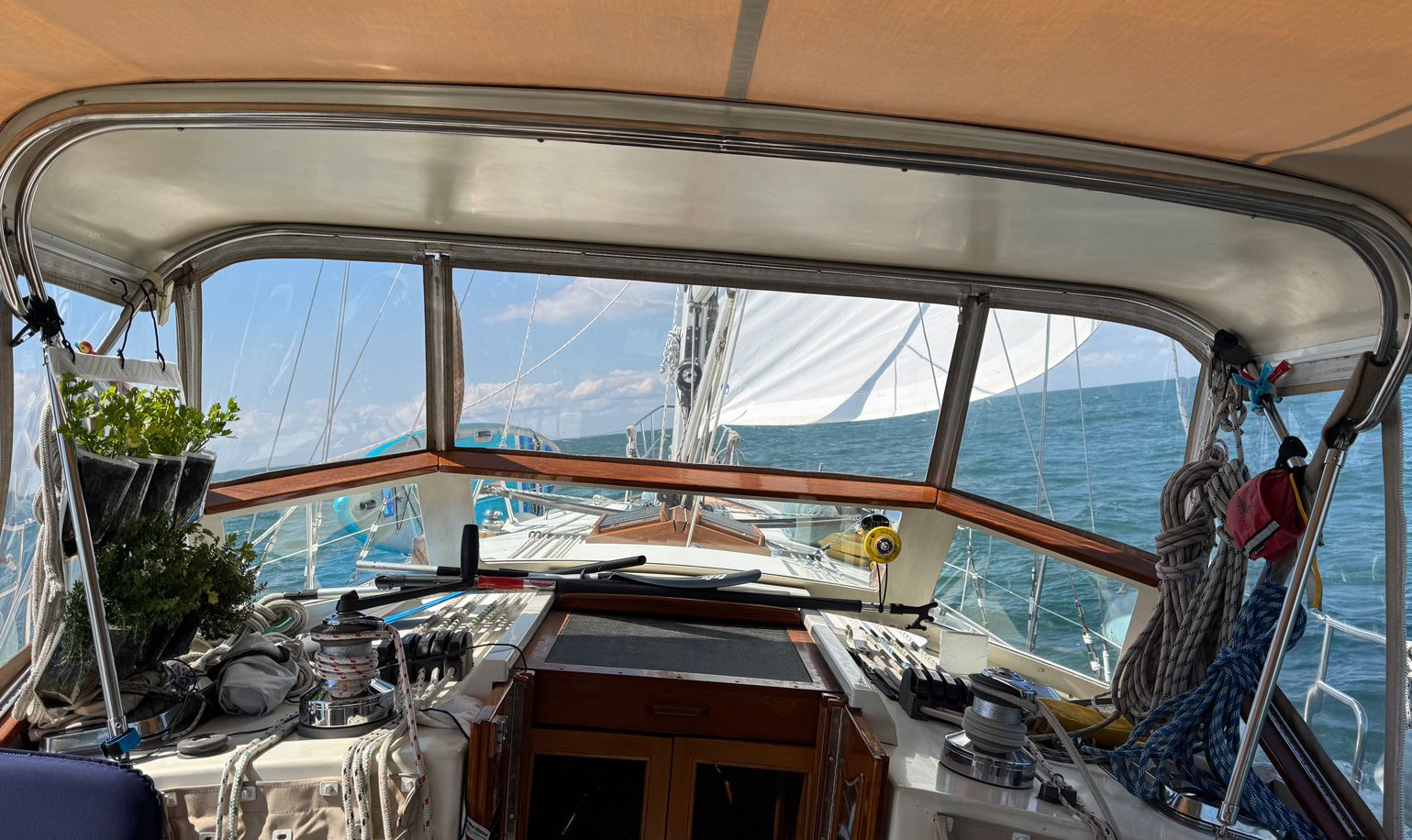
As soon as Gaviidae was secured to the dock, we walked the half mile to the ice cream venue, where the evening farmer’s market was going on. We love going to farmers’ markets and search them out whether we are on the boat or in the RV. Peaches and plums were in peak season in Wilson, along with fabulous, sweet corn.
On August 27th, we moved to the Port Dalhousie Pier Marina located in St. Catharines, Ontario. We had a lovely sail from Wilson, although we did have to deviate to avoid running through the middle of the J/111 World Championship races near Youngstown, NY.
Customs with a bit of Humour
Our two nights in Wilson required us to clear back into Canada as we approached Port Dalhousie. When I called in, we were told that if no Customs agents arrived within 5 minutes of our arrival at the marina, we could leave the boat. We pulled into our designated slip with assistance of our dock neighbors to see three Canadian Border Patrol agents standing at the head of the dock. All three had big smiles on their faces – not something you usually see with Customs agents. They strode down the finger pier, still smiling. They wanted to be the first to welcome us to “Lake America”! We all had a good laugh, and they wished us a safe journey through the Welland.
Crew Check-In
The next day, we moved Gaviidae to the Port Dalhousie Yacht Club where we had arranged to meet our volunteer crew. We had the “A” team for our line-up. The first to arrive were Amy and Missy, who have been boating since they were in diapers and have a passion for going through canals. We had met them in 2015 at a Great Lakes Cruising Club Rendezvous in Rogers City, MI. Howard and Kerri-Ann, who sail on our first Gaviidae, arrived next. H&KA helped us through the Welland on the downbound transit. They arrived with all the essentials – grungy gloves, 8 foot 2x2s, lifejackets, popcorn, and the makings for Manhattans!
After a day of boat prep, laundry, vehicle shuttling, and snack runs we enjoyed a lovely dinner at The Twisted Pig. With full tummies, H&K-A retired to their AirBnB and the rest of us returned to Gaviidae for our last night on Lake Ontario. Yes, it is Lake Ontario and will always be Lake Ontario!
The Adventure Starts
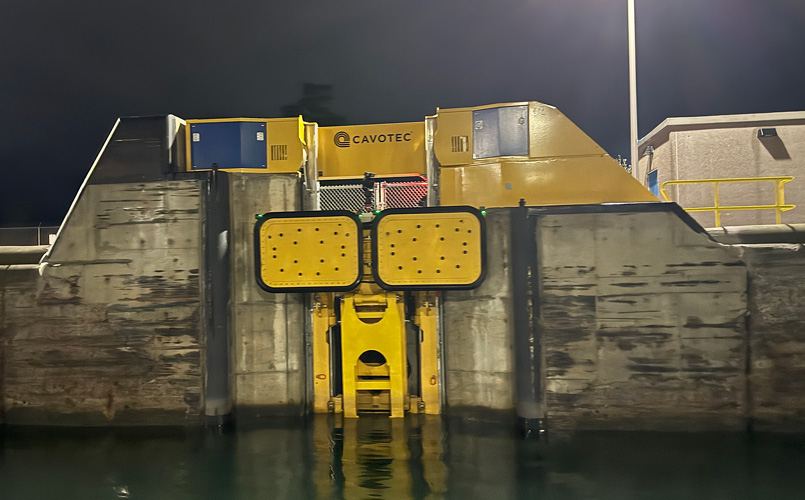
The official start time for upbound on the Welland was 9AM. The owners of MV Be’na.do, who helped us dock at Port Dalhousie and hailed from Green Valley AZ, had hired a local expert to be their third person. Roger, the expert, informed us it was best to be there around 8AM. We also learned that there would be six recreational boats going through together. This guaranteed that either someone would be rafted to us or we would be rafted to someone else.
At 7AM, we cast off the lines and headed for the entrance to the Welland Canal. By 8AM we were tied to the wall at the starting dock – MV Be’na.do was already there with Roger onboard. As we waited for the other boats to arrive, Roger speculated that it was going to be a very long day. There was lineup of cargo ships waiting outside the entrance to the canal – and they pay $23K CDN for the transit compared to our measly $200 CDN fee. Money talks and they also have size in their favor!
The First Delay
We checked in with the Welland Operation Control Centre as required and were informed that we would not start until 9:30-10:00AM. In the meantime, the other boats scheduled for the day started to arrive and join us on the wall. Aside from Roger, our boat had the most experience doing locks. Roger learned from the Control Centre that we would be delayed until 11:00AM or, most likely, much later due to the number of cargo ships waiting.
The Welland Canal is just over 26 nautical miles (NM) long and has a speed limit of 6 knots. If there were no locks, it would take 4 hours to travel the distance. But there are 8 locks and each one takes at least 45 minutes – more when boats must get secured to the wall and have other boats raft to them. In an absolute perfect world, it would take just over 10 hours. The worst-case scenario that I heard of was 18 hours!
Go!
Around 11:00, Roger relayed that we would be squeezed in after the cargo ship in Lock 1 exited and before the next cargo ship entered. The Welland Seaway Control Centre also determined who was going to raft to whom – we were the second largest sailboat and therefore, we were instructed to raft to the 50’ Sun Odyssey SV Star IV. The first two locks had a starboard (right-side) tie.
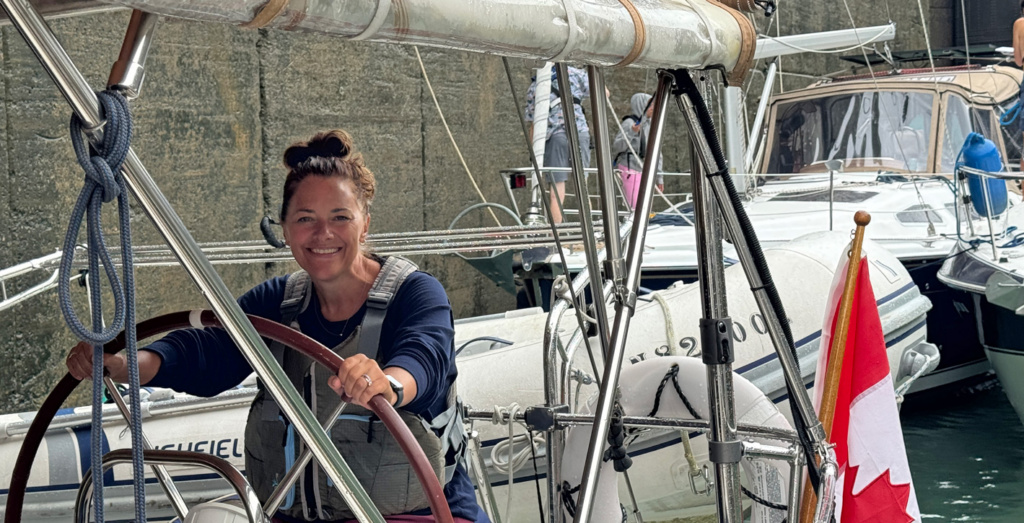
Star IV is what AIS was displaying, however we were told the name would be changing in the near future. The owners (Dan and Marsha) had just purchased the boat in Toronto and were taking it to Midland, Ontario in Georgian Bay. To ensure we don’t bring the wrath of Poseidon down on them, we’ll refrain from using the new name.
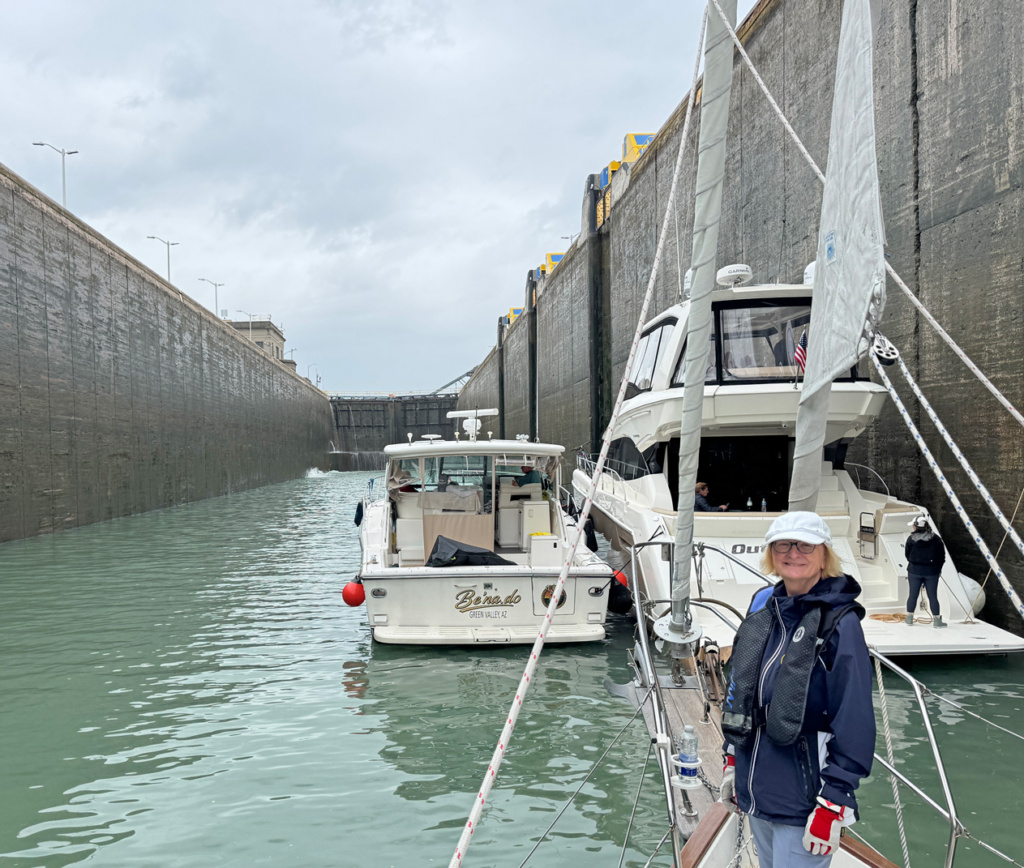
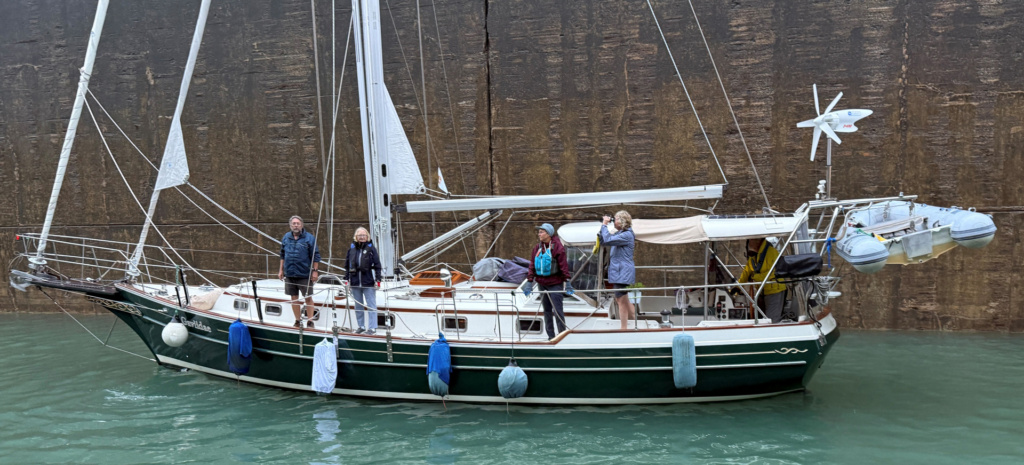
In locks 1-3, the two larger power boats went in first. Our new buddy boat, Star IV was next and grabbed the bow and stern lines dropped down by the lock crew. Once secure, we deployed our fenders and tied to them. They had four on board and we sent our four crew over to assist along with extra fenders. Of course, the trusty 2x2s were ready to be deployed as well. Much better to drop a 2×2 than an expensive boat hook – and they float! By noon, all six boats were in the lock and ready for the first lift of approximately 46 feet.
What a Rush
The Welland lock crew (team of three) can control the flow of water to some extent in the first three locks. The first lock taught us all a lesson or two as the boat surged forward and back with the huge influx of water. While we expected the worst to be at the beginning, it was in the middle of the fill where you could see the turbulent water rushing past the boats.
Seeing that all of the boats were struggling to maintain control with bow-thrusters working overtime, they slowed the water flow down a bit for Locks 2 and 3.
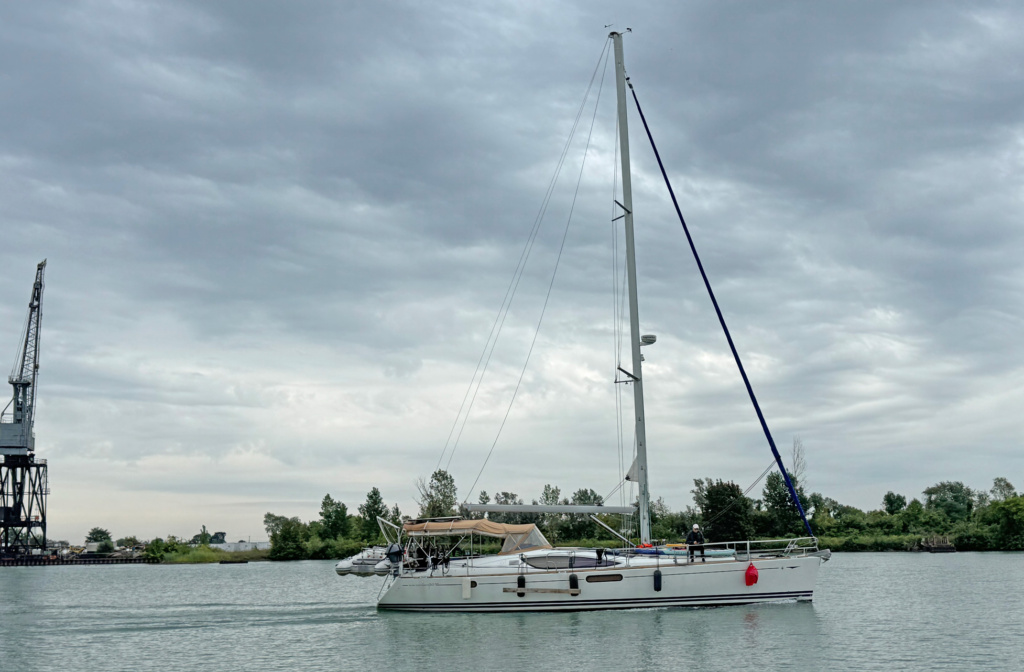
Fender Board
After Lock 1, we realized that our unused fender board might help keep Star IV off the wall as the line-up of their fenders and our extra round ball fenders were just barely enough. A fender board is typically a 2×6 or 2×8 of ~8’ in length that is used between the lock wall and the fenders to distribute the pressure more evenly down the length of the boat. It is tied on to the lifelines or rail at the widest part of the boat (mid-section).
Dan (new owner on SV Star IV) and I figured out a rhythm where I would try to use Gaviidae’s bow thruster while he used theirs. We also would go into reverse at the same time if we were surging forward too much.
Lock 3
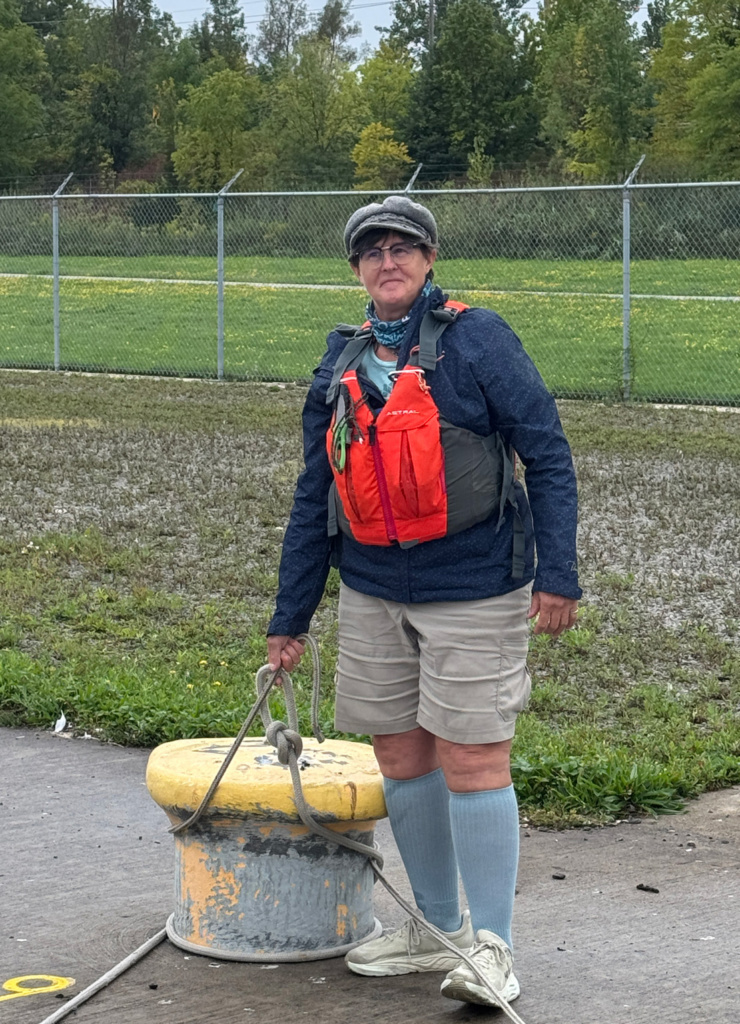
For Lock 3, all boats switched to a port-side tie on the wall. We also had another delay waiting for a cargo ship to clear out of the lock. Most of the boats opted to tie to wall using the giant bollards designed for the cargo ships. Not knowing how long the wait would be, we circled around rather than tie up. We didn’t expect it to be too long as there was already a ship in the lock ready to be lowered.
Bad choice on our part as we ended up circling for two hours and then were instructed to tie along the wall to stay out of the way of the ship. It was almost 5:30PM by the time we entered Lock 3!
Another Delay
Lock 4 has a bascule railway bridge at the entrance to the lock. A bascule bridge either lifts up from one side or splits in the middle allowing boat traffic to proceed. We watched the railway bridge lift into the up position and waited for the green light to come on. And waited. And then waited a bit longer.
To torment us just a bit more, the bascule bridge suddenly went back down. No explanation. Thirty minutes later, a four-car GoTrain passed over. We waited an hour for a tiny commuter train! Oh Welland!
The Stair Step Locks
Continuing with port side ties to the wall, we (and Star IV) were instructed to go first into Lock 4. Apparently, the turbulence is less in the front on Locks 4-6. These locks are unique in that you exit the lock immediately into the next lock, getting raised almost 140 feet!
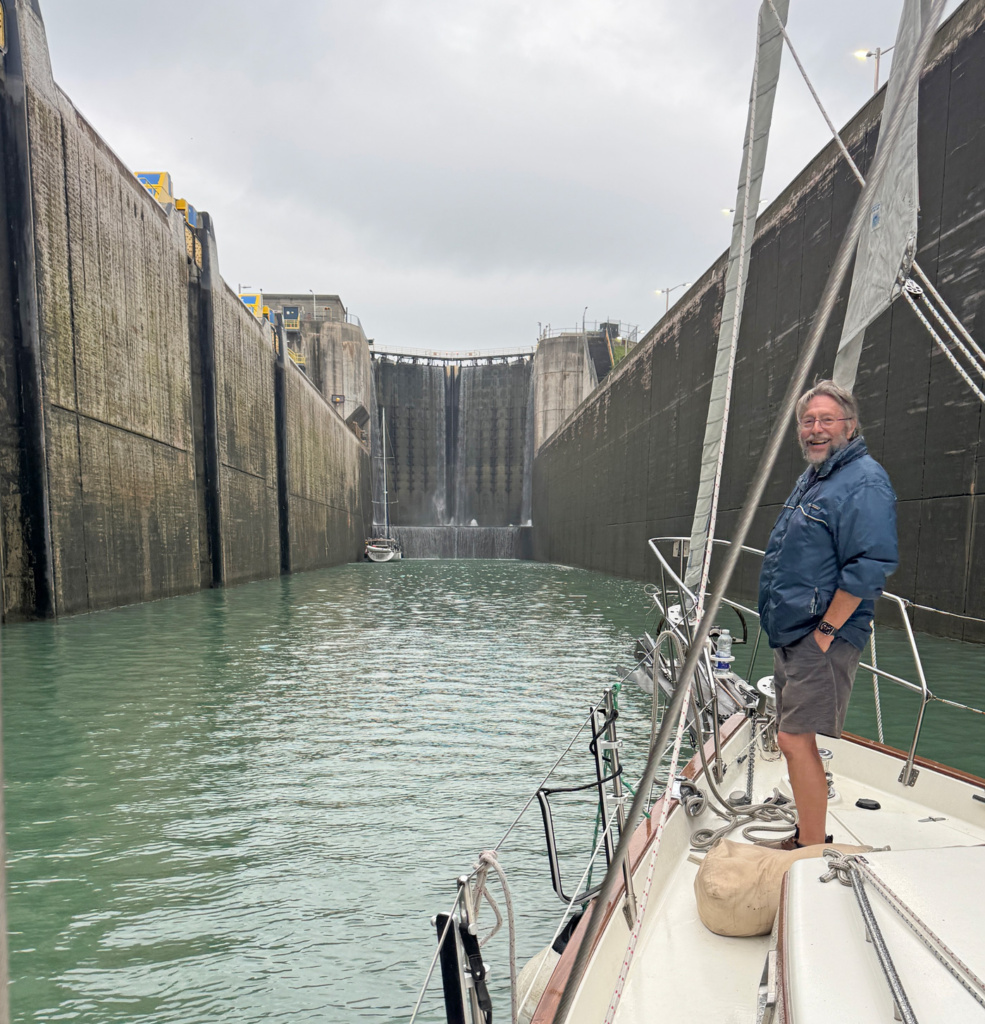
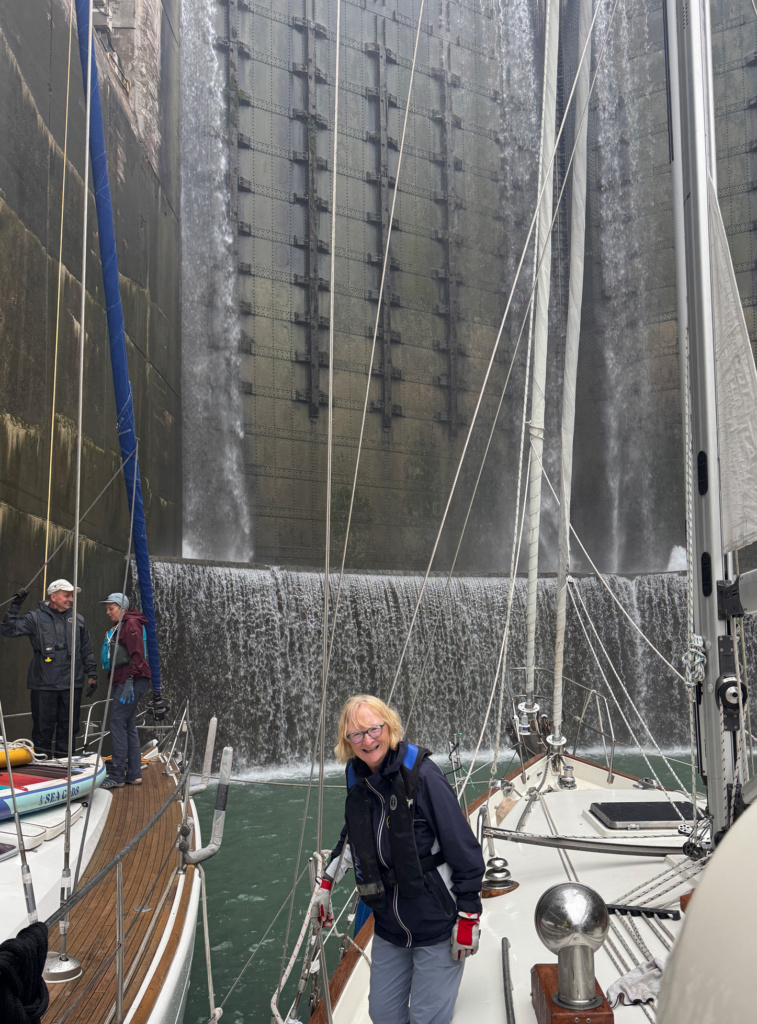
These locks are also parallel locks, so the water from one side empties into the other side using gravity to raise one ship and lower the other. The water fills from tubes in the middle, which is why they wanted the sailboats as far forward as possible. Star IV moved to the very front, almost touching the 10’ raised area directly at the front of the lock.
Not Your Everyday Amusement Park Ride
We thought we’d gotten a pretty good system in place with Locks 1-3. We did, but as the swirling water pushed the two boats forward requiring us to go hard in reverse and at the same time keeping an eye on the sailboat behind us who also surging forward. There was lots of yelling back and forth between crew members on all the boats as they wrestled to control their wayward vessels. In Locks 4-6, the lock crew has no control over the water flow!
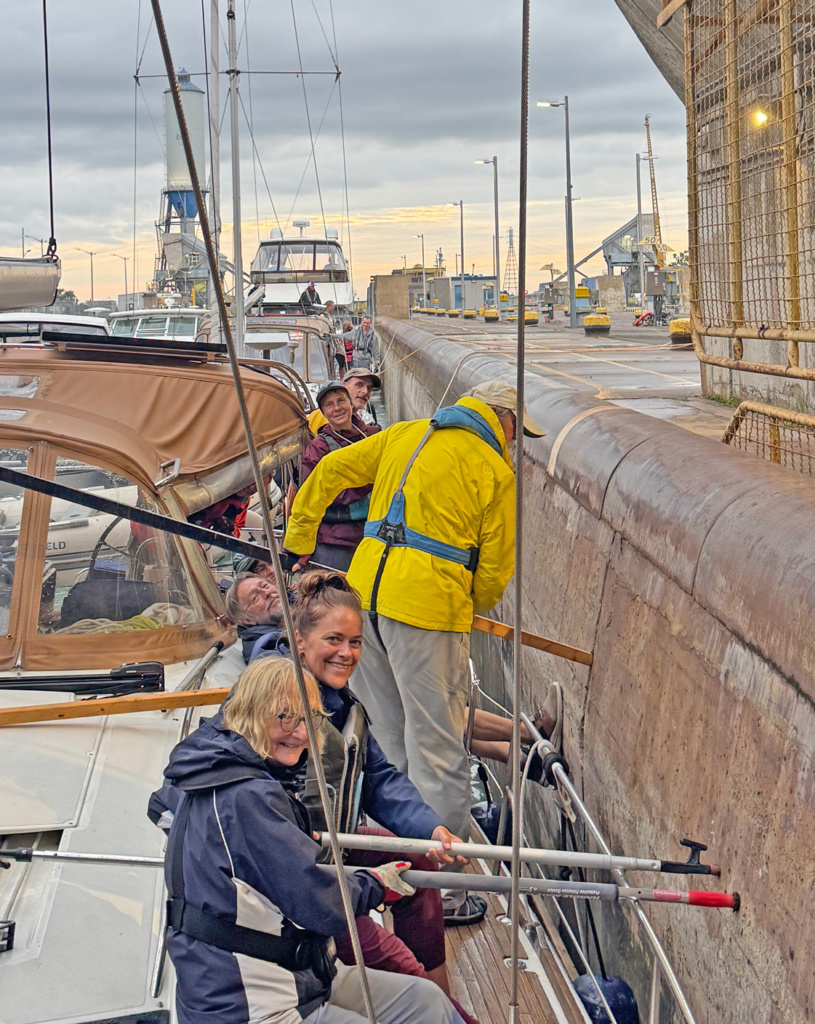
The line handlers on the front and back struggled to keep our two very heavy boats in place with five people pushing off the wall with all their might. Missy figured out that sitting on the boat deck and pushing off with her legs provided much needed leverage. Some of the other crew followed suit. Daniel commandeered one of the 2x2s and helped Jim when the boat surged forward.
At one point Dave, the stern line handler, was pinned between the wall and the boat, and it looked like he was about to get squished. This happened simultaneously with yells from the bow to move the boats back as we were getting too close to the front of the lock. It was a tense but brief moment until the boats were back under control with some heavy use of reverse and the bow thrusters.
Smiling Faces
Despite the physical strain on the combined crew on Star IV, a steady run of boat tales and jokes kept everyone laughing. One ongoing line of humor was Missy speculating as to whether the cargo ships departed each lock with giant hickeys from the vacuum seals! Missy also shared her homemade cookies which also helped the camaraderie between the two boats.
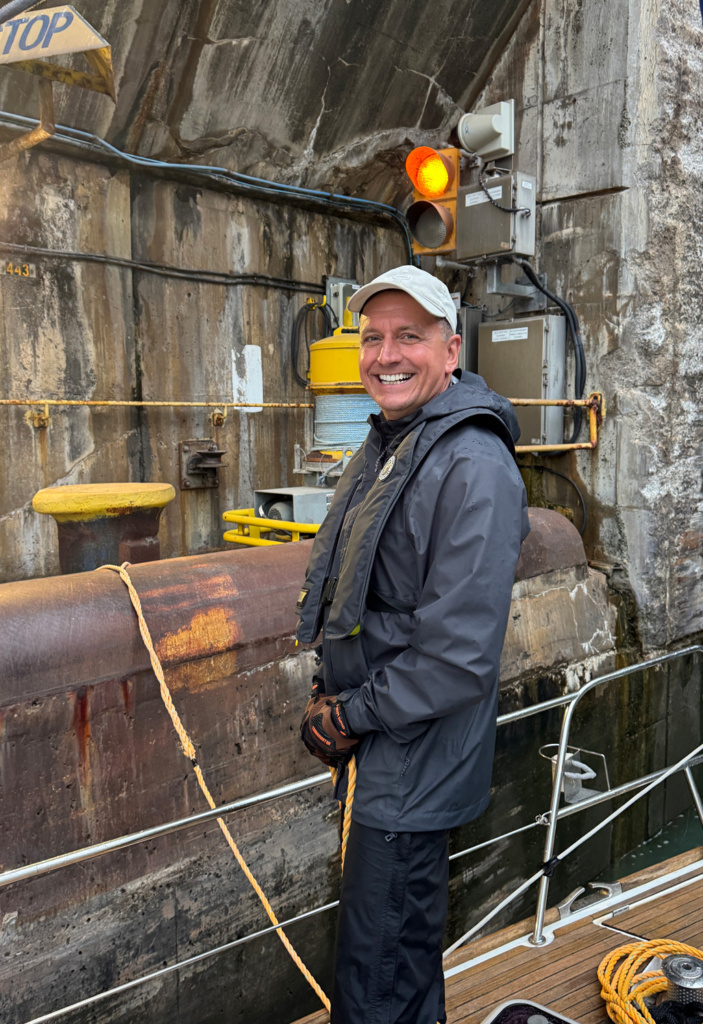
By the time we exited Lock 5, Star IV lost power to their bow thruster. Thinking his bow thruster had drained the dedicated battery, Dan (on Star IV) went below and fired up their generator. He quickly determined that it was more serious than a power issue, his bow thruster had called it quits.
Some of our smiling faces disappeared as we realized that Gaviidae would be pulling both heavy boats off the wall with it’s 6 horsepower bow thruster. With fingers crossed that our bow thruster stayed operational, we proceeded into Lock 6. Gaviidae didn’t really need more than one person on board, so all five of our crew were on Star IV to help push off the wall.
Lock 7 and the Long Haul
The next lock was just a short distance from the stair locks but by this point it was well after dark and starting to rain. We cleared the lock at 9:45pm and then had almost 14NM to transit to the final lock. Daniel went below to start making a Mexican Cornbread casserole (hot dish for those from Minnesota) for dinner.
My eyesight at night and in the rain is not ideal as every light is amplified with the reflection. Worried that I might put the crew in harms way, I asked Howard to take over the helm. A couple of us took turns using our shower squeegee to clear the water off the windscreen.
While the speed limit was supposed to be 6 knots, it was clear that the other boats said to hell with that and roared ahead. Between the current and the wind, Howard pushed the throttle forward so we could maintain just over 6 knots.
The Last Lock
With the five other boats waiting for us, we arrived at Lock 8 just after midnight. This lock is an adjustment lock meaning that it only raises or lowers a short distance to match the water level on the other side. Once you enter the lock, you simply hold position as the water level rises. No lines, no tying to a wall.
It was raining hard by the time we got out of the lock and heading toward Sugarloaf Marina in Port Colborne. Daniel took over the helm for our approach to the marina.
Our prior knowledge of the marina layout didn’t help much as we entered the confusing entrance in the dark. We used our spotlight to shine on a building that was at waters edge and to spot the unlighted buoys. At this point it was almost 1AM and our memory failed as to the location of the long transient dock. We took a wrong turn and ended up in the area where the service dock was located. Realizing our error, we did an about-face and found the long dock. Star IV moved further up the dock to give us space and helped us get tied up.
Dinner is Served
Dinner was out of the oven and at 1:30AM, we had a fashionably late meal. The food was the perfect comfort food after an extremely long day – 18 hours! The smiles were still there, just not as quick to respond as everyone was exhausted. Howard and Kerri-Ann retired to their AirBnB and the rest of us crashed on Gaviidae. There were no alarms set.
Never Again
Going upbound on the Welland was an experience. Having a great crew with positive attitudes helped immensely. We are very thankful Amy, Missy, Howard and Kerri-Ann were brave (and foolish) to join us for the adventure. Also very thankful we were paired with SV Star IV who remained gracious throughout the challenges.
The Gaviidae gang however, all decided that once was enough and we would never do the Welland Canal again!
Note: Before we departed Sugarloaf Marina, we met a cruiser that came through the next day. He was the only boat! But he still dealt with a bow thruster that failed during the day!
I love reading about your sailing experiences! I feel like I was there too. Love from warm, sunny SW Florida!